Pakistan today faces a crisis that extends far beyond the familiar political confrontation between the government and opposition. In different parts of the country, questions of political representation, provincial autonomy, economic inequality and security have produced sustained unrest. Three regions in particular—Pakistan-occupied Jammu and Kashmir (PoJK), Balochistan and Khyber Pakhtunkhwa (KP)—illustrate the depth of these problems. Though the nature of resistance in each region is different, a common thread runs through them: growing dissatisfaction with a political system that many residents believe has failed to address their aspirations. In Pakistan-occupied Jammu and Kashmir, public discontent has increasingly acquired an economic and political character. For years, Islamabad has exercised considerable influence over the territory while its people have faced economic difficulties, unemployment and inadequate infrastructure. The region possesses considerable strategic importance, yet ordinary residents continue to complain about high electricity costs, limited employment opportunities and the rising cost of living. The protests that intensified in recent years demonstrated that public frustration cannot simply be dismissed as an isolated political campaign. Demands concerning electricity, flour prices, taxation and governance reflected everyday grievances. The central contradiction is particularly striking. Pakistan has historically projected PoJK as evidence of its commitment to the Kashmiri cause, but the treatment of the territory itself has frequently raised questions about how much political and economic authority is actually available to its elected institutions. The gap between political rhetoric and conditions on the ground has therefore become increasingly difficult to conceal.
Balochistan represents an even deeper challenge. It is Pakistan’s largest province by area and possesses enormous reserves of natural resources, including natural gas, minerals and other strategic assets. Yet Balochistan remains one of the country's least developed regions. Many Baloch nationalists argue that the province has not received a fair share of the wealth generated from its resources. Questions surrounding resource control, enforced disappearances, security operations and political representation have fuelled resentment for decades. The Baloch insurgency has consequently become one of Pakistan's longest-running internal conflicts. Successive governments have attempted military, political and developmental responses, but none has permanently resolved the underlying grievances. Heavy-handed security measures may suppress unrest temporarily, but they cannot substitute for political reconciliation. Every disappearance, violent incident or confrontation risks deepening mistrust between the population and the state. The situation in Khyber Pakhtunkhwa is different but equally serious. The province has suffered enormously from militancy, particularly after the rise of extremist organizations in the tribal belt and their spillover into settled districts. Ordinary people have paid a heavy price through deaths, displacement, damaged infrastructure and disruption of economic activity. Although Pakistan's security forces have conducted numerous operations against militants, violence continues to periodically return.
The merger of the former Federally Administered Tribal Areas with Khyber Pakhtunkhwa was presented as a major political reform, but implementation has remained challenging. Development, policing, employment and governance in the merged districts continue to require sustained attention. Meanwhile, political dissatisfaction has grown among sections of the population who believe that promises of rapid development have not been adequately fulfilled. Taken together, these three regions expose a fundamental weakness in Pakistan's model of governance. Islamabad has often responded to regional discontent primarily through administrative control or security measures rather than addressing the political causes behind it. Such an approach may produce short-term stability, but it rarely creates durable peace.
There is also an important difference between the three fronts. In PoJK, the strongest public mobilization has often centred on economic rights and political autonomy. In Balochistan, the issue is closely connected with nationalism, resource control and a long-running insurgency. In KP, the dominant concerns include militancy, security and the effectiveness of provincial governance. Treating all three simply as "security problems" therefore misses the real picture. Pakistan's challenge is consequently not merely about defeating armed groups. It is about rebuilding trust between the state and populations that increasingly question whether Islamabad understands or represents their interests. Unless political grievances, economic disparities and demands for meaningful local representation are addressed, instability in these regions is likely to remain a recurring feature of Pakistan's internal landscape. The three fronts—PoJK, Balochistan and Khyber Pakhtunkhwa—therefore represent three different manifestations of the same larger crisis: the difficulty of governing a diverse country through excessive centralization, coercion and political neglect. For Pakistan, the real test is not how effectively it can contain dissent, but whether it can address the reasons why that dissent continues to emerge.
By: Aatif Ahmad
aatifahmadkashmiri@gmail.com
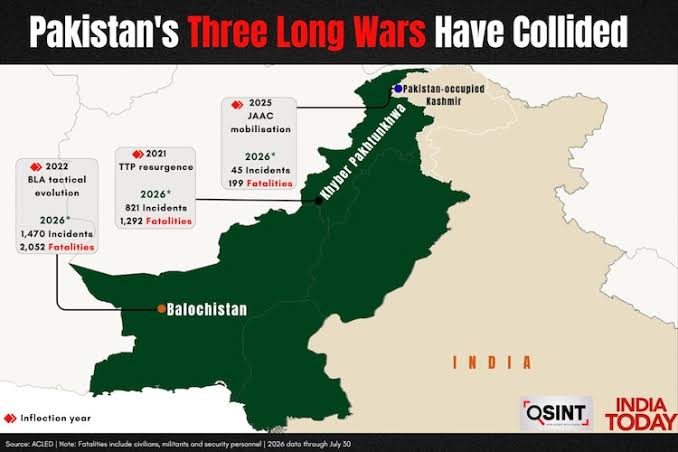
The three fronts—PoJK, Balochistan and Khyber Pakhtunkhwa—therefore represent three different manifestations of the same larger crisis.