There are some conversations that do not need to begin with complicated questions. Sometimes, they begin simply with people sitting together, listening to one another and discovering that much of what connects them has been there for generations. This is the idea behind Mulaqaat, an interfaith dialogue initiative of the Save Youth Save Future Foundation that has recently brought people from different communities together in Baramulla and Pulwama. The initiative received an important push when Lieutenant Governor Manoj Sinha launched it during his interaction with volunteers of the Foundation at Lok Bhavan in June this year. The initiative is built around a fairly simple thought: Kashmir's social fabric cannot be understood only through its differences. Its history is also a history of shared memories, traditions, cultural practices and places that have been part of the lives of different communities.That makes the idea of dialogue particularly relevant. In a society where younger generations are growing up amid rapid social and technological changes, opportunities to meet, speak and listen to people from different backgrounds can become important in their own right.
The Foundation has placed youth at the centre of this effort. Its larger work has also included community outreach and campaigns related to substance abuse and youth participation. During his interaction with the volunteers, the Lieutenant Governor called upon young people to become ambassadors of a drug-free Jammu and Kashmir and encouraged them to contribute to building a healthier and more prosperous society. Mulaqaat takes that engagement into another area — social harmony.The Baramulla programme was part of this larger effort to create a space where people from different communities could meet and discuss their experiences and shared heritage. Rather than presenting harmony as an abstract slogan, the initiative has attempted to make it a lived conversation among ordinary people.
The same approach was visible in Pulwama, where the dialogue brought together representatives and participants from Hindu, Muslim, Sikh, Christian and Kashmiri Pandit communities. The discussions centred on peace, coexistence, mutual respect and the shared values that have connected people in Jammu and Kashmir.
The Pulwama programme also reflected the role being played by the Foundation's own team. Mudasir Ahmed Dar, South Kashmir Zonal President of the Save Youth Save Future Foundation, delivered the welcome address. Anika Nazir, Women’s Wing President, spoke about the purpose of Mulaqaat and the importance of dialogue and mutual respect. Wajahat Farooq Bhat, Chairman of the Foundation, later delivered the vote of thanks.Their involvement is significant because the initiative is not being presented simply as an official programme. It is being carried forward through an organisation whose work involves young people and community-level engagement.For Anika Nazir, the involvement of the women's wing also brings another dimension to the conversation. Women are not merely observers of social change. They are often at the centre of families and communities and have a direct role in shaping the attitudes of younger generations. Giving them space in conversations on harmony makes such initiatives broader and more representative.Mudasir Dar's role in the South Kashmir outreach similarly reflects the effort to take the conversation beyond Srinagar and established institutional spaces. If interfaith dialogue is to have meaning, it has to reach towns, villages and communities where people actually live.Wajahat Farooq Bhat, meanwhile, has continued to position the Foundation's work around youth participation and social concerns. The Foundation's interaction with the Lieutenant Governor before the launch of Mulaqaat also included discussions around its community initiatives and the importance of involving young people in constructive social activity.
The participation of the Lieutenant Governor in the initiative has added an institutional dimension to the conversation. In Pulwama, he spoke about a broader roadmap involving regular interfaith dialogues, youth peace ambassadors, preservation of shared heritage, digital literacy and countering misinformation. He also suggested Village Peace Committees representing different sections of society. But perhaps the most important aspect of Mulaqaat is what happens after the stage is cleared and the speeches are over.Dialogue cannot be created through one event. It becomes meaningful when people continue speaking to each other afterwards. The real test is whether young people who meet through such platforms carry those conversations back to their schools, colleges, neighbourhoods and social circles.
The phrase “Save Youth, Save Future” therefore acquires a wider meaning. Saving the future is not only about protecting young people from drugs or giving them educational and employment opportunities. It is also about giving them a social environment where differences can be discussed without becoming divisions.
Kashmir has enough history, culture and lived experience to sustain such conversations. Its shared heritage is not something that belongs exclusively to one community. It is made up of countless stories, traditions and memories that have travelled across generations.
Mulaqaat is, at its heart, an attempt to bring some of those stories back into conversation.From Baramulla to Pulwama, the initiative has demonstrated that interfaith dialogue does not necessarily have to begin with grand declarations. It can begin with a meeting — a mulaqaat — and with the willingness to listen. That may be a modest beginning, but in matters of social trust, modest beginnings often matter most.
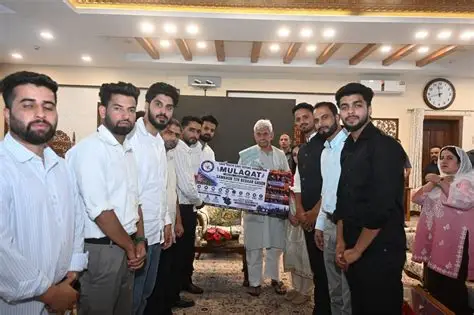
The initiative received an important push when Lieutenant Governor Manoj Sinha launched it during his interaction with volunteers of the Foundation at Lok Bhavan in June this year.